


Key takeaways
- As SaaS companies grow, they need infrastructure that will grow with them.
- Companies might need to scale up (adding resources to servers) or scale out (adding more systems, in more locations) depending on their growth strategies.
- A hybrid model often provides the best approach to scaling, enabling companies to scale out in the cloud for bursting apps while scaling up with bare metal for steady-state workloads.
For Software-as-a-Service (SaaS) businesses, growth is an imperative. They might want to deepen their product portfolio or expand into new geographies—but nearly all intend to acquire more customers and increase revenue.
As these businesses grow, their technical infrastructure must grow with them. They need the resources for developing new products and supporting more customers, wherever those customers are located.
There are two primary ways to scale infrastructure. A company might scale up, adding more compute power to servers to accommodate heavier workloads—like AI model training or large database operations. Or a company might scale out, adding more systems across a network to facilitate growth in new regions or to handle occasional spikes in customer demand.
It’s rarely an either/or situation. Many companies need to scale up and out at some point in their journey. The challenge is designing an IT architecture that can do both without requiring major overhauls when the company’s scaling requirements change.
Scaling Up: Bigger Machines for Heavier Workloads
When it’s time to buy a server, most teams carefully evaluate their current workload and try to predict how that workload will grow over the lifespan of the server. They configure the server with the optimal number of cores, the right amount of memory, and sufficient storage capacity to meet current needs while providing adequate room to grow.
Buying too little is a big problem. No one wants to come up against the resource limits of a server too soon. At the same time, buying too much—a server with much more resources than necessary—is wasteful. Underutilizing server resources is one of the reasons that the tech industry moved into virtualization and cloud computing: Organizations did not want to pay for resources that would sit idle.
Of course, even if teams optimize the server configuration for current needs while leaving an appropriate amount of capacity for the future, they could still run out of headroom over time. When the workload grows past the provisioned resources, it’s time to scale up (or scale “vertically”).
If the team moves up to the next hardware tier from the same vendor, that move can be seamless. The team doesn’t have to re-learn how to manage the server: The machine might have a faster processor, more memory, or larger storage capacity, but the way the team runs it stays the same.
It’s relatively simple to determine when to scale up with a bare metal infrastructure. Teams can monitor resource utilization and a variety of other metrics to identify when they are approaching a server’s physical limits. By contrast, it can be more difficult to assess headroom for cloud resources. Since those resources are often virtualized and shared among multiple tenants, teams need to track metrics such as application latency, which can indicate when it’s time to resize their cloud instance.
Scaling Out: More Systems in More Places
Scaling out—or “horizontal” scaling—generally involves buying more of the same type of system. SaaS businesses often scale out when they want to extend their reach. If a company is working to acquire customers in a new region, it might need to deploy hardware closer to those customers to reduce latency. Meanwhile, keeping data close to customers can help SaaS companies adhere to data residency regulations.
SaaS companies also scale out to improve availability and resiliency. Adding redundant servers in multiple geographic zones helps ensure that an outage in one data center won’t completely crash an application. Moreover, those redundant systems help support temporary spikes in demand.
Scaling out geographically—whether with an infrastructure or cloud provider—requires the provider to have multiple global locations. The provider needs data centers on the continents and in the countries where resources are consumed.
In the best scale-out scenario, the SaaS business would work with a single provider in all locations. Doing so would enable teams to simplify system procurement, management, and maintenance.
Taking a Hybrid Approach
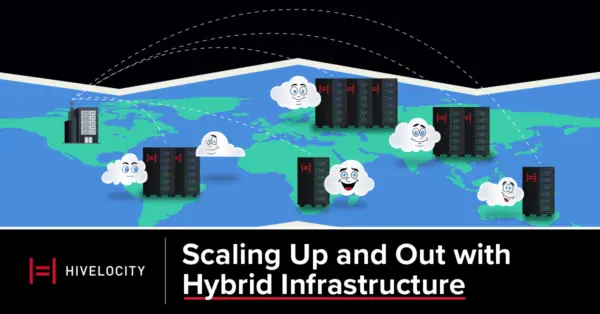
SaaS businesses and other organizations often decide to run some workloads in the cloud and other workloads on dedicated infrastructure. In fact, according to a recent survey, 98% of IT leaders have adopted or plan to adopt a hybrid IT model.1
With its ability to handle sudden bursts, a hyperscale cloud might be the best location for applications and other fluctuating workloads. Meanwhile, steady-state workloads—like databases that do not need burst capacity—are often the best fit for bare metal.
Both dedicated infrastructure and cloud environments can scale up and out. But because cloud environments offer greater resource elasticity, they are often a better choice for providing the scale-out capacity needed for bursting applications. Meanwhile, companies can scale up dedicated infrastructure as databases grow and scale out when expanding to new geographic regions.
With the right infrastructure provider, scaling out will be as seamless as scaling up. Teams should be able to keep their existing infrastructure-as-code (IaC) workflows intact.
Preparing to Scale SaaS with Hivelocity
The Hivelocity SaaS Bundle includes three tiers of bare metal infrastructure that enable SaaS companies to scale up and out as their business grows.
- Engineering Compute: Companies can start with development, staging, and non-production infrastructure plus a small single-tenant production environment.
- Production Compute: When it’s time to scale up, this tier enables businesses to implement multi-tenant SaaS platforms running clusters for application servers, databases, or both, where shared cloud I/O would be a performance problem.
- Hi-Scale Compute: This enterprise SaaS tier is for businesses whose database has outgrown the shared cloud and whose disaster recovery (DR) has become too expensive. Businesses can choose multi-region active or active-passive deployments.
With a hybrid model, the business can keep the application tier on the cloud while deploying the database and DR on bare metal with Hivelocity. This architecture enables SaaS companies to scale up and out to support business growth while balancing performance, control, and costs for key workloads.
Learn more about how Hivelocity supports SaaS businesses.
FAQs
Q: What is the difference between scaling up and scaling out?
A: Scaling up means increasing the compute power, memory, or storage capacity of a server. Scaling out involves adding more servers to share the workload. SaaS businesses scale up to support more demanding workloads. They scale out to expand geographically, improve resilience, or handle demand spikes.
Q: Why do many SaaS companies adopt a hybrid IT model?
A: With a hybrid model, SaaS companies can run steady-state workloads on dedicated, bare metal infrastructure while running applications in cloud environments. The elasticity of cloud resources enables them to scale out to support sudden demand spikes. Meanwhile, the bare metal infrastructure provides more consistent performance and predictable costs.
Q: How can Hivelocity help SaaS companies scale up and out?
A: Hivelocity enables SaaS companies to scale up to higher-tier machines for more resource-intensive workloads, and to scale out into more regions and countries, all while working with the same vendor and using the same operating model. With Hivelocity, companies also have the flexibility to use the cloud for applications that require burst capacity.
Citations
1CoreSite, 2025 State of the Data Center, May 2025
