
Key takeaways
- For streaming platforms serving educational institutions, infrastructure decisions have a critical impact on their ability to maintain margins.
- Cloud services with per-GB egress fees can reduce margins as streaming platforms expand their business to support growing demand.
- Bare metal infrastructure with flat monthly pricing helps platforms maintain margins while improving reliability and compliance.
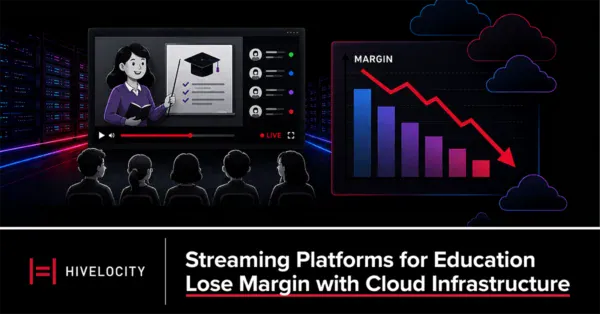
Streaming platforms that serve educational institutions face increasing margin pressure if they use hyperscaler infrastructure. When demand for streaming services grows, margins shrink. Each time a university expands its continuing education offerings or a professional development session becomes a synchronous broadcast, cloud fees for data egress rise. And the streaming platform has to pay.
Streaming for education does not behave like consumer over-the-top (OTT) video-on-demand (VOD) catalog traffic, which runs at a relatively constant load. Education streaming is also different from streaming for live sports events, which experiences massive short-term spikes.
Instead, education streaming traffic is concentrated in a few recurring windows, such as 9 AM to noon and 1 to 4 PM. Those morning and afternoon windows repeat across a semester. Usually, there are only a few all-institution events—like convocations, emergency announcements, or synchronous professional development days—where a much larger group of people are streaming content simultaneously.
This predictable traffic pattern should be advantageous to the streaming platforms serving these institutions. Platform teams know when the heavy loads are coming, and they can plan accordingly.
Unfortunately, hyperscale cloud infrastructure was not designed for this kind of predictability. It was designed to provide elasticity for accommodating sudden bursts of traffic. Organizations with bursting workloads can benefit from a data egress model that charges for the amount of data leaving the cloud at any time. But for most streaming platforms that serve educational customers, that cloud pricing model only chips away at profitability.
Understanding Reliability Requirements for Educational Streaming
For streaming platforms supporting educational institutions, each recurring window of traffic is effectively a live broadcast. As students log into online classes, the infrastructure handles key streaming processes, including ingest, transcoding, packaging, and origin delivery. Those processes have strict deadlines.
When streaming platforms use shared cloud environments, there is a very real possibility that platforms will miss those deadlines. The workload scheduler for the cloud environment has multiple workloads to schedule, from multiple vendors, and will not necessarily prioritize a stream for synchronous online classes.
CPU scheduling variances that occur during those streaming windows can diminish user experiences. Students and faculty could see dropped frames, encoding artifacts, or frustrating buffering errors. For students in particular, these kinds of errors can serve as significant distractions that impair their ability to learn.
Running those streaming workloads on single-tenant bare metal eliminates the variability that can cause poor user experiences. With this kind of infrastructure, the CPU is not shared. There is no workload scheduler that may or may not delay live ingest and transcoding.
Many organizations—including streaming platforms—use shared cloud infrastructure in their early stages of development. When egress volume is low and flexibility is essential, a shared cloud makes perfect sense. But for streaming platforms, cloud advantages begin to disappear as platforms grow. If a platform adds new schools and supports more synchronous sessions, a shared cloud is no longer the best fit for delivering reliable experiences while maintaining a decent margin.
Experiencing Shrinking Margins with Growing Egress Costs
Streaming platforms typically sell to educational institutions on multi-year contracts with fixed per-seat pricing. That pricing is set using a cost model that assumes the streaming platform will spend a certain amount on infrastructure. If the data egress bill from a cloud provider grows faster than the contract value, the platform loses margin.
That egress bill grows as educational institutions stream more content—and those institutions are doing just that. One recent report found that student demand for online classes is driving 65% of surveyed institutions to offer more online classes.1
Hyperscaler cloud egress pricing is not aligned for this type of growth. It was designed for the sudden spikes of usage that accompany new product releases or retail holiday sales. Because education streaming does not require that kind of elasticity, platforms are often stuck paying large egress bills for a capability they don’t need.
Those bills can be sizable. Delivering a single petabyte of data from a hyperscaler could cost a streaming platform up to $50,000 in egress fees alone, plus the cloud native CDN charges.
Fortunately, there is an alternative. If streaming platforms use bare metal infrastructure instead of the cloud, they can take advantage of flat monthly bandwidth pricing, designed for sustained egress rather than bursting. This approach not only saves platforms money; it also enables them to avoid having to renegotiate institutional contracts to recover their margin.
These infrastructure decisions, then, have significant implications for the business. While staying with cloud environments can shrink the margin, moving to a bare metal infrastructure can help platforms maintain that margin, even as their business grows.
Meeting Compliance Obligations
As streaming platforms contemplate a move to bare metal infrastructure, they must find infrastructure providers that can help meet compliance obligations. Streaming platforms that serve educational institutions handle student data—and they must protect that data to comply with regulations. For example, depending on the institution type and the age of the student population, platforms might have to adhere to the Family Educational Rights and Privacy Act (FERPA) (for K–12 and higher-ed institutions) or the Children’s Online Privacy Protection Act (COPPA) (for children under 13).
Because FERPA and COPPA cover application-layer and data-handling obligations, the streaming platform vendor and the institution must comply—not the infrastructure provider. Still, the infrastructure provider can offer an important foundation for information privacy and security.
For a streaming platform, selecting the right infrastructure provider can in fact dramatically simplify compliance—and that can help the platform close new contracts. Streaming platforms need to meet SOC 2 Type II standards, which aim to keep customer data (or in this case, student data) secure. If a streaming platform can produce a clean SOC 2 Type II audit report from an infrastructure provider, the platform can reduce the number of questions it must answer on a security questionnaire from a prospective client by 60 to 70%.2
For a platform selling into K–12 districts or universities with formal procurement processes, having that report from an infrastructure provider in hand can provide a real competitive advantage. And it can accelerate the sales process.
Delivering Seamless Experiences for Students
Whether in on-campus dorm rooms or in their homes multiple time zones away, students start streaming a university class just as a professor walks to the lectern. Behind the scenes, there were multiple technology decisions that made this moment possible. For streaming platforms, choosing bare metal infrastructure helps ensure that the student experience is seamless—there are no glitches that can interrupt the flow of learning.
That same infrastructure decision can help the streaming platform maintain its margin, even as the university and other clients expand their online learning options. By paying a flat monthly fee instead of variable costs for data egress, the platform can continue to scale its business and deliver those seamless experiences without losing its margin.
Learn more about how streaming platforms benefit from dedicated single-tenant infrastructure.
FAQs
Q: How does cloud infrastructure reduce a streaming platform’s margin?
A: Cloud providers charge per-GB data egress fees. This pricing model makes sense for organizations that have large, unexpected spikes in traffic. But streaming platforms supporting educational institutions have predictable traffic windows and customer contracts based on fixed costs. By using cloud services, platforms must pay more as streaming demand grows, thereby reducing platform margins.
Q: How can bare metal infrastructure help streaming platforms maintain margins?
A: Bare metal infrastructure providers can offer flat monthly fees for bandwidth. As a result, streaming providers can set multi-year contracts with educational institutions knowing that their infrastructure costs—and their margin—will not change.
Q: How can infrastructure providers help streaming platforms with compliance?
A: Infrastructure providers can deliver audit reports demonstrating compliance with key data security and privacy frameworks. Streaming platforms can use those reports to assure prospective customers that student data will be protected. That assurance creates a competitive advantage and accelerates the sales process.
Citations
1Quality Matters, CHLOE 10: Meeting the Moment: Navigating Growth, Competition, and AI in Online Higher Education, August 2025
2Wolfia, What Is a SOC 2 Report? A Complete Guide for 2026, March 2026
