Key takeaways
- Moving AI from experimentation to production introduces real-world challenges around performance, power, and cost.
- The NVIDIA L4 Tensor Core GPU gives organizations a highly efficient, single-slot form-factor accelerator for inference, graphics, and video workloads.
- Combining the NVIDIA L4 GPU with bare metal gives organizations consistent access to GPU resources and enables them to retain control of where data lives.
NVIDIA released its Ada Lovelace graphics processing unit (GPU) architecture to help innovators achieve AI-powered breakthroughs. Named after a visionary, the architecture is enabling other visionaries to bring their ideas to fruition.
In the 1830s, an English inventor named Charles Babbage developed his vision for an “Analytical Engine” — a machine that could perform any calculation.1 Ada Lovelace, an English countess and friend of Babbage, saw even greater potential for this calculator. She suggested that the engine could manipulate not only numbers but any symbolic information, including letters and even musical notes.
This sort of proto-computer was not built during Babbage’s or Lovelace’s lifetimes. The concept was sound, but continuous design changes, manufacturing limitations of that time, and financing issues stalled attempts at production.
That story of innovative vision but an inability to bring the vision to life might be familiar to AI teams today. Organizations are turning away from frontier-scale models and putting smaller, tuned models into production for everyday AI workloads. But bringing those models into production creates a different set of real-world challenges. Can you run AI inference at production volume, every day, for real users, at a reasonable cost?
Exploring the Highly Efficient NVIDIA L4
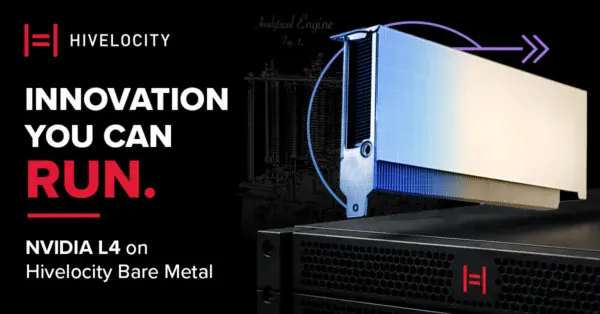
Not long after launching the Lovelace architecture, NVIDIA released the NVIDIA L4 Tensor Core GPU—an energy-efficient, low-form-factor accelerator for AI inference, video, graphics, visual computing, and additional use cases. It combines 24 GB of GPU memory, 300 GB/s of memory bandwidth, fourth-generation Tensor Cores, and third-generation RT Cores in a single-slot form factor.2 That 24 GB memory footprint is well suited to many of the smaller, quantized language models organizations are putting into production today.
Importantly, it draws only 72 watts of power. For most of the last decade, accessing this level of acceleration has required organizations to expand power and cooling capabilities. But with this efficient GPU, organizations can focus on their configuration choices instead of planning facilities projects. They can include more cards per server and more servers per rack. Moreover, they can deploy those servers in regional facilities rather than only in a handful of purpose-built AI data centers.
The Tensor Cores are doing serious work. Fourth-generation Tensor Cores support lower-precision formats (that is, they perform operations using fewer data bits), which improves performance and enhances efficiency for AI inference. They are purpose-built for the operations that organizations run millions of times a day.
This GPU is also genuinely multi-purpose. While most accelerators are good at one thing, this card is designed for:
- Generative AI inference: Serving text and image generation at volume with a low cost per request
- Video transcoding: Supporting live streaming pipelines and AI video analytics
- Real-time rendering: Providing ray tracing and rendering for dispersed creative and engineering teams
This flexibility further increases infrastructure efficiency.
Why This GPU Is the Right Choice for AI Inference
There are three key reasons why the L4 Tensor Core GPU will be the right GPU for organizations running AI inference: efficiency, deployment flexibility, and predictable costs.
For many organizations with AI-powered workloads, optimizing the economics for AI inference is essential. A relatively small number of companies train AI models, then, a wide range of other organizations run them, millions of times. Teams running smaller, tuned models don’t necessarily need expensive training-class hardware designed for peak performance. The L4 Tensor Core GPU provides the foundation for cost- and energy-efficient inference.
This GPU also offers deployment flexibility. With low power requirements and a single-slot form factor, organizations can deploy servers with this GPU close to users, in multiple locations. They no longer have to relegate GPUs to centralized facilities, whose distance from users creates latency.
Finally, the L4 Tensor Core GPU is readily available. Predictable availability is an underrated—but extremely important—attribute. When a team knows technology is available, they can start enacting their plans, instead of waiting in a queue that delays projects.
Of course, this L4 GPU is not for every organization or every use case. For organizations training large models or serving models with a memory footprint beyond 24 GB, this is not the right card. However, for inference, video, and graphics at production volume, it is difficult to argue with its benefits.
Combining NVIDIA L4 and Hivelocity Bare Metal
Using GPUs with dedicated, single-tenant hardware helps further reduce the obstacles to AI-powered innovation. For example, using dedicated hardware, organizations do not have to share the accelerator with other infrastructure tenants. Moreover, they can control that infrastructure, which can help them meet stringent regulatory requirements.
Hivelocity offers dedicated, bare metal servers with NVIDIA L4 Tensor Core GPUs to help your organization optimize efficiency and reduce the costs of AI inference. NVIDIA L4 configurations are available in Tampa 1, Tampa 2, Los Angeles, and Dallas locations, giving you options for placing inference workloads close to users.
By choosing dedicated hardware from Hivelocity with NVIDIA L4 Tensor Core GPUs, you can overcome the real-world obstacles that can slow AI innovation. Start exploring Hivelocity GPU configuration options now.
FAQs
Q: What is the NVIDIA L4 GPU designed for?
A: The NVIDIA L4 Tensor Core GPU is designed for AI inference, video processing, and graphics workloads. It offers high efficiency for those workloads in a single-slot form factor. It is not the best fit for large-scale model training.
Q: Why is the NVIDIA L4 a good choice for AI inference?
A: For AI inference workloads, organizations need hardware that can reduce the cost of each request and increase throughput per watt. The NVIDIA L4 Tensor Core GPU supports lower-precision formats that increase performance and efficiency. Its lower power draw and single-slot profile further reduce costs and enhance deployment flexibility.
Q: Can you train AI models with the NVIDIA L4?
A: Hivelocity’s L4-enabled servers are optimized for small language models (SLMs) with large, specialized data sets. A perfect fit for regulated industries with elevated data protection requirements.
Q: Why run NVIDIA L4 GPUs on bare metal instead of in the cloud?
A: With dedicated bare metal, you don’t have to share an accelerator with other infrastructure tenants. In addition, you can retain control over where the inference runs and where data resides, which can help facilitate compliance with data sovereignty and data residency requirements.
Q: Why use dedicated infrastructure for small language models?
A: Smaller, tuned models can handle many production AI tasks without the compute requirements of larger frontier models. Running them on dedicated infrastructure gives you control over your models, data, and serving environment while providing predictable infrastructure costs.
Citations
1Science Museum, Charles Babbage’s Difference Engines and the Science Museum, July 2023
2NVIDIA, NVIDIA L4 Tensor Core GPU
