
Key takeaways
- Load times in EHR systems or medical imaging archives create significant friction in patient, provider, and staff experiences.
- Cloud multi-tenancy is a common cause of delays in the clinical data tier; shared resources can introduce resource competition that impacts latency-sensitive workloads.
- Hivelocity offers single-tenant, bare-metal infrastructure as a service (IaaS) for steady-state healthcare workloads, including EHR systems and imaging archives.
According to the AMA Journal of Ethics, clinicians spend nearly 50% of their time working in the EHR system, and only 27% is spent face to face with patients.
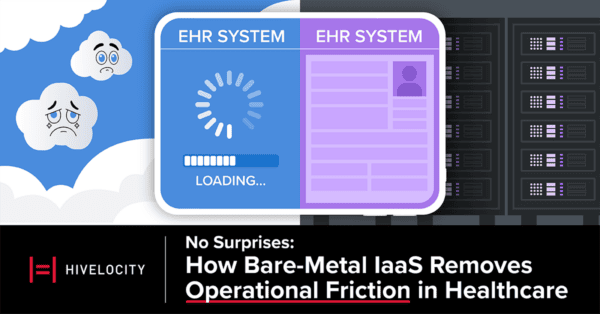
Here’s one of the reasons why: loading screens. The Clinician EHR Experience 2025 report by KLAS Research found that at 80% of the organizations measured, fewer than 70% of clinicians agreed their EHR has a fast response time.
It’s an all-too-common scenario: doctors trying to pull up scan results find themselves staring at a spinning circle. Why? One possible cause is resource contention from another tenant on shared infrastructure. But five minutes and two patients later, the same scan opens instantly.
Of course, impacted users will submit support tickets. And IT staff will spend hours trying to fix the issue. But oftentimes, it’s simply out of their control.
The Problem: Multi-Tenant Shared Hardware
So what’s happening? The VM the doctor is relying on is one slice of a physical server. The other parts are being used by other organizations. And when these other tenants initiate a backup or a heavy batch job, it can cause latency for everyone else on the shared disk. IT teams may not have the host-level visibility needed to confirm the source of the problem.
This issue, which is intrinsic to multi-tenant cloud environments, has a significant ripple effect. EHR systems and imaging archives serve thousands of requests per hour. Long delays create a measurable impact on operational efficiency, which translates to lost time and increased frustration for everyone involved.
The Solution: Bare-Metal, Single-Tenant IaaS
Cloud providers offer dedicated capacity to help solve the multi-tenancy problem—but it comes at a premium price. So what can you do instead?
Single-tenant, bare-metal IaaS provides a compelling solution. In this model, you get the whole physical server, disks included. With no co-tenants on the server, one common source of shared-resource variability is removed.
Opting for this approach helps remove the lengthy wait times that drag down patient, provider, and staff experiences. With the right capabilities exposed, bare-metal IaaS solutions can even deliver an experience that matches how IT teams are currently working in the cloud, which helps facilitate a smooth switch.
Furthermore, hyperscale cloud resources are priced with an elasticity premium built in. This makes sense: burst capabilities are an essential part of the cloud value proposition. But most workloads in the clinical data tier follow a predictable demand pattern that doesn’t require on-demand elasticity. As they investigate the bare-metal option and their true workload requirements, healthcare organizations often find that they’re overpaying for burst capabilities they don’t truly need.
Remove Shared-Tenancy Frustration with Hivelocity
Hivelocity provides a bare-metal, single-tenant hosting solution that’s ideal for your clinical data tier workloads such as EHR systems and imaging archives.
Running on our dedicated single-tenant hardware, you don’t encounter any shared-tenant surprises. Avoiding the elasticity premium built into hyperscale cost structures also allows you to support these workloads with greater cost efficiency. Additional capacity can easily be provisioned to support predictable spikes in demand or growing needs.
Our HIPAA-ready infrastructure provides single-tenant bare-metal IaaS for steady-state healthcare workloads. Everything is backed by 24/7/365 support from real humans who understand healthcare infrastructure requirements. To maintain their familiar workflows, IT teams can easily take advantage of our infrastructure-as-code and API-driven provisioning capabilities.
Of course, not everything can or should move from the cloud. In fact, many of our healthcare customers have opted for a hybrid setup. Research jobs and imaging AI training runs come and go, so they can stay on cloud, where paying for elasticity makes sense.
Optimizing workload placement is a top-of-mind concern for healthcare organizations. With three distinct, purpose-built infrastructure tiers—from development/staging environments to production workloads and protected compute—Hivelocity is ready to help you enable more consistent experiences across clinical and operational workflows.
FAQ
Q: What is the noisy-neighbor problem in cloud hosting?
A: Your virtual machine shares a physical server with other tenants. When one of them runs something heavy, like a backup or a batch job, it can add latency for everyone sharing those disks. Your monitoring shows the slowdown but not the cause, because the host isn’t yours to see.
Q: Does this mean leaving the cloud?
A: No. The clinical data tier moves to dedicated single-tenant hardware, where its steady load fits the pricing. Elastic work, such as research jobs and imaging AI training runs, stays on cloud, where paying for elasticity makes sense.
Q: Why not just buy dedicated capacity from a cloud provider?
A: You can, but it’s sold at a premium on top of standard rates. Single-tenant bare metal skips that surcharge because nothing was shared to begin with. You get the whole physical server, disks included, and a co-tenant can’t slow your reads because there isn’t one.
Citations
- AMA Journal of Ethics, EHRs, iPatients, and Clinician Well-Being, November 2025
- KLAS Research, Clinician EHR Experience 2025, June 2025
