

Key takeaways
- Beyond providing support and maintaining uptime, IT teams today are expected to contribute directly to business initiatives.
- When highly skilled engineers must spend time on facilities maintenance, tech-driven innovation slows.
- Colocation facilities alleviate the burden of maintaining facilities, allowing internal teams to stay focused on high-impact work.
Technology teams have never been asked to do more. IT has evolved from a support function into one of the primary drivers of business transformation. IT teams today play central roles in enabling AI initiatives, strengthening cybersecurity, modernizing applications, supporting hybrid workforces, improving customer experiences, and helping executive leadership make data-driven decisions.
Despite these expanded responsibilities, expectations for IT continue to rise. Business leaders want to accelerate new technology deployments, prevent cyber attacks earlier, and completely transform operations.
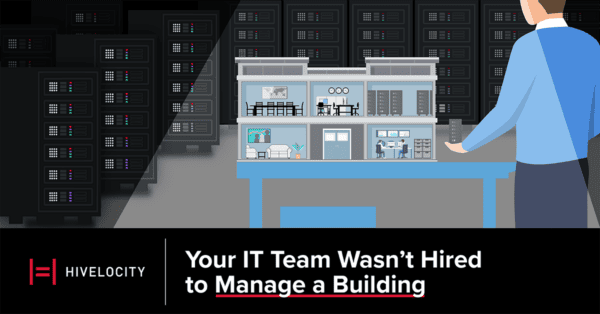
The problem is that many IT teams are still dedicating too much time to activities that have little to do with innovation. They’re managing buildings. Specifically, IT teams are coordinating cooling maintenance, planning electrical upgrades, orchestrating physical access, scheduling vendor visits, testing backup power systems, and responding to any facility-related events that emerge.
Those tasks are all necessary. But are they the best use of highly skilled (and highly paid) technology professionals?
Tracking the Changing Success Metrics for IT
For years, IT infrastructure teams were largely measured by system availability. If the servers stayed online and the network remained operational, leaders considered IT infrastructure teams to be successful.
Today, the success metrics have shifted considerably. Infrastructure teams are increasingly measured on their contributions to business growth, customer experiences, and operational efficiencies.
That shift in what defines success should led to a clear redefinition of roles. But in fact, IT infrastructure team members are still responsible for system availability in addition to everything else. They are being asked to become strategic partners for business initiatives while also keeping the lights on. The expansion of roles makes it much more difficult for organizations to hire and retain highly skilled personnel.
Recognizing Engineering Talent as a Highly Valuable Resource
Experienced IT professionals have become very difficult to recruit and even harder to retain. Organizations are competing for engineers who have expertise in cloud architecture, cybersecurity, AI, networking, and platform operations. When they find the right people, organizations often have to pay a premium to hire them.
Given how challenging and expensive these searches are, many IT leaders
should re-evaluate roles. They need to recognize that skilled engineers can create the greatest value for the business by designing more resilient architectures, automating repetitive processes, improving cybersecurity posture, and accelerating business initiatives. Those engineers should not be spending inordinate amounts of time maintaining facilities.
Measuring Opportunity Costs
What happens when skilled personnel continue to be assigned maintenance tasks? Organizations can’t use those skills for more strategic work. When an experienced infrastructure professional has to troubleshoot a data center power issue, install a new server rack, or inspect a fire-suppression system, innovation slows.
The cost of these necessary distractions is not just lost time. These difficult-to-retain engineers would rather be working on innovative projects. Organizations might face staff departures the more they ask team members to deal with facilities management.
Removing Operational Burdens with Colocation
Choosing purpose-built colocation facilities can help organizations remove the burden of operating and maintaining facilities that house IT systems. With colocation services, power, cooling, physical security, environmental monitoring, and around-the-clock operational support become the responsibility of the colocation vendor—not the skilled IT staff of the organization that needs uninterrupted workload availability.
While public cloud environments might seem to offer similar benefits, colocation facilities have an important advantage: They enable organizations to continue using their own dedicated hardware. That’s essential for supporting workloads with unique performance, security, and compliance requirements. Colocation allows organizations to shift responsibility for facility operations without giving up ownership or control of their technology. Internal IT teams remain responsible for the applications, systems, security, and business outcomes that create competitive advantage.
For many organizations, the move to colocation is like buying back engineering capacity. Those highly skilled engineers, who are difficult to acquire and retain, can now focus more of their time on interesting, high-value work.
Refocusing on the Strategic Impact of IT
Maintaining system availability will always be a baseline requirement. But organizations should not have to pull their internal staff away from other projects just to keep systems running. They should focus their engineers on tasks that will deliver the greatest value to the business. Moving to a colocation model often gives organizations a simple way to regain that focus while maintaining rigorous availability.
Learn more about how to reduce the burdens of facilities management with colocation.
FAQ
Q: How have IT responsibilities evolved?
A: Many IT teams used to be primarily responsible for user support and system availability. Today, they are asked to be strategic partners, playing key roles in launching new tech-driven initiatives that give organizations a competitive advantage.
Q: Why do expanded IT responsibilities present a business challenge?
A: Highly skilled engineers are often pulled away from high-impact strategic work to manage and maintain facilities infrastructure. Innovation slows and organizations face personnel retention issues when skilled engineers are unable to work on strategic projects.
Q: How can colocation facilities help IT teams focus on high-impact work?
A: Purpose-built colocation facilities remove the burdens of managing facilities infrastructure, such as power, cooling, physical security, environmental monitoring, and around-the-clock operational support. Internal IT staff can concentrate on projects that make full use of their skills.
