Key takeaway
- Many healthcare organizations received unexpectedly high cloud bills, even though they closely monitor big-ticket costs.
- Expenses for data egress, idle resources, storage management, security capabilities, and other items can add up quickly.
- Bare metal infrastructure eliminates several of these costs, giving healthcare organizations greater visibility and control over spending.
Many financial leaders for healthcare organizations struggle to understand why their cloud bill keeps increasing. After all, they closely monitor the top-line items like the costs of compute, storage, and database services. The problem is that underneath those obvious big-ticket costs are many more smaller costs that continue adding up.
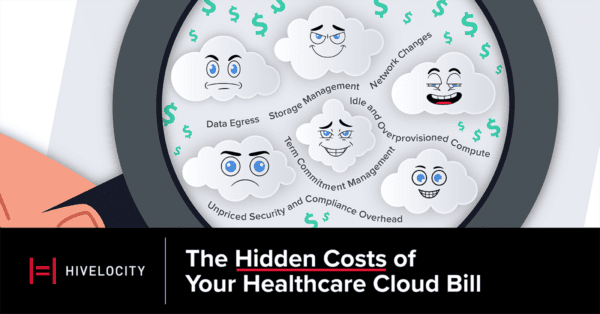
The rising cost issue is difficult to ignore. According to Flexera’s report, cloud waste increased to 29% in 2026.1 Healthcare organizations need to understand why the cloud bill keeps increasing, even when finance thinks the big items are under control. There are six areas that deserve scrutiny.
1. Data Egress
Hyperscale cloud providers typically charge for data egress: moving data out of the cloud. For healthcare organizations, data egress charges can grow quickly for PACS environments. Imaging files are large and often retrieved repeatedly by clinicians, referral partners, research teams, and downstream applications. Storage costs might look predictable, but retrieving and transferring clinical images add variable costs. AI workloads compound egress charges since images are constantly flowing between systems.
2. Idle and Overprovisioned Compute
Most organizations overprovision their cloud resources to help ensure adequate application response. But as a result, cloud instances routinely run at a fraction of their provisioned capacity. While using shared resources with burst capabilities can eliminate the need for overprovisioning, organizations pay a per-gigabyte premium for that burst flexibility.
Moving to a microservices model can help. Using Kubernetes, for example, automates resource management, which can reduce costs.
3. Storage Management
Healthcare organizations need to store massive amounts of data. Images and healthcare records must be retained for years to comply with regulations. Finance leaders have accounted for storage capacity, but not all have factored in the additional administrative time (and money) required to manage the lifecycle of all that data.
4. Network Changes
Healthcare organizations evolve, and so do their networks. An organization’s network could look very different in five years after acquiring hospitals or clinics, or even adopting new SaaS applications. Those types of network changes make budgeting very difficult. Organizations could accumulate unforeseen data egress fees from new cloud locations as well as micro-transaction networking fees.
5. Term Commitment Management
Organizations typically reserve instances or Savings Plans to avoid unpredictable cloud costs. Those reserved instances/Savings Plans can require upfront term commitments. For workloads that change over a term, commitments must be managed to avoid economic waste. Teams need to end commitments they no longer need and then make new commitments for new resources. The time spent on management can add yet another unexpected cost.
6. Unpriced Security and Compliance Overhead
Security and compliance generate major expenses in healthcare. But it can be very difficult for organizations to figure out what they’re truly spending money on. Security charges are often buried across hundreds of line items in a cloud bill. So, for example, teams might be unable to determine which applications are running up their security costs. And furthermore, they will have difficulty making important decisions that weigh costs versus risks.
Addressing Healthcare Infrastructure Costs with Bare Metal
Using dedicated, bare metal infrastructure can help healthcare organizations avoid many unexpected cloud costs. For example, with the right infrastructure provider, organizations can eliminate data egress costs and network charges. They can move images and records among systems in hybrid infrastructures without having to pay transfer fees. Organizations can also avoid under-utilized resources by provisioning hardware for their particular workload profiles: They no longer have to prepare for some other organization’s need for resources.
Meanwhile, healthcare organizations regain control over security and compliance, and the costs associated with those efforts. With a shared-responsibility model, the infrastructure provider handles physical, environmental, and network controls while offering attestations that can help with HIPAA compliance. The healthcare organization is responsible for application security, access controls, data encryption, and overall compliance.
For healthcare organizations looking to address runaway cloud expenses, the first step should be evaluating current workload costs against a dedicated infrastructure model. In many cases, organizations can trade hidden, unexpected costs for more predictable expenses.
Learn how Hivelocity can help you address rising cloud costs for healthcare.
FAQ
Q: What are some of the hidden cloud costs that healthcare organizations experience?
A: Healthcare leaders carefully monitor big-ticket costs, such as expenses for compute, storage, and database services. But costs related to data egress, idle resources, term commitment management, storage management, network changes, and security can be difficult to track.
Q: How does bare metal infrastructure help avoid hidden costs?
A: The right infrastructure provider will eliminate fluctuating fees for data egress and bandwidth. By using single-tenant hardware, organizations can also avoid the need to overprovision resources or pay for burst flexibility. And by clearly defining security and compliance responsibilities, organizations establish more predictable spending.
Q: Does moving to bare metal eliminate all hidden cloud costs?
A: No. For example, organizations still need to manage the operational costs of handling storage growth and network expansion. But bare metal eliminates egress fees and the premium paid for flexible (shared) cloud resources.
Citations
1Flexera, 2026 State of the Cloud Report, March 2026
