
Key takeaways
- Many SaaS organizations find that the database is both the biggest performance bottleneck and one of the largest line items on the cloud bill.
- Shared cloud infrastructure can hinder database performance while inflating costs.
- Repositioning the database to dedicated bare metal removes the noisy-neighbor variable, changes the performance ceiling, and reduces costs.
Is your organization paying for elasticity you don’t truly need? Much of today’s SaaS stack doesn’t require the premium, burst-capable infrastructure offered by today’s hyperscale clouds—but lives there anyway. One of the most common culprits is the database.
If you’re wondering why yours is so consistently expensive, it could be because it’s currently running on the wrong infrastructure. The good news is that shifting to a hybrid approach where databases and other steady-state workloads are on bare metal while bursty workloads stay in the cloud can solve the problem.
Multi-Tenant Hardware Creates Database Problems
Running your SaaS database in the cloud can lead to higher costs and reduced responsiveness. From a cost perspective, it’s typically the largest line item on the bill. Every new customer adds rows, indexes, replicas, and storage. From a performance angle, everything upstream waits on it, so when the database drags, the whole product seems slow.
Both problems point back to an undeniable truth: in the cloud, you’re renting a slice of someone else’s hardware. Shared I/O isn’t deterministic, and it was never meant to be. Your performance takes a hit even when your database appears to be running steadily. Engineers chase ghost issues because they can’t reach the problem on hardware they don’t own.
The Bare-Metal Advantage
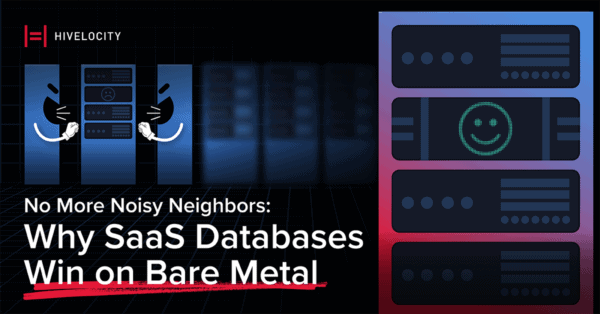
Bare-metal infrastructure offers real advantages to SaaS providers. Since there are no other tenants on the hardware, there’s no possibility of noisy-neighbor problems. Everything is dedicated to your workloads. Nothing gets in the way.
The result is that your 99th-percentile of latency stabilizes since no other tenants are competing for the same I/O. You can size storage to what the workload needs, and replica traffic stays on private VLANs instead of the public internet. Ultimately, you get more performance with a lower bill.
Your potential for reducing costs through this change is significant. According to Datacenters.com, moving steady-state workloads to dedicated hardware can create TCO reductions of up to 40%.
Your Whole Stack Doesn’t Need to Move
An important point of distinction is that you don’t need to totally move away from cloud. In fact, a hybrid approach is often the best option. Certain parts of the stack can stay on cloud infrastructure, because their traffic is bursty, which makes elasticity worth the premium. Meanwhile, the database and its replicas move to dedicated hardware.
At Hivelocity, our bare-metal offering comes accompanied by private, high-speed links into AWS, Google Cloud, and Azure to keep traffic between the two layers fast and separate from public internet. This means your team’s day-to-day workflow stays the same, and engineers don’t have to switch to unfamiliar tools. With our API parity, your existing IaC pipelines run unchanged. Platform teams keep using the tools they already use.
Simplify Workload Repositioning with the Hivelocity SaaS Bundle
The Hivelocity SaaS Bundle provides a streamlined way to realign your workloads for maximum efficiency and performance.
By taking advantage of the bundle, you can place your database on our Production Compute infrastructure (Tier 2). Doing so, you get a bare-metal home for Postgres, MySQL, and their associated cache and search layers. This ensures the database performance you need by avoiding the common cloud issues we outlined earlier.
If the database expands beyond a terabyte, or shifts into multi-region production, you can move it to our Hi-Scale Compute (Tier 3). This environment also supports customer-built disaster recovery and a wider regional footprint. When your procurement team is looking to validate compliance, our SOC 2 Type II report across core facilities is ready for their due diligence.
The Hivelocity SaaS bundle also includes Engineering Compute (Tier 1), which can be used to support development, staging, and other non-production needs.
Start Optimizing Your Workload Placement with Hivelocity
Repositioning SaaS workloads for better cost-efficiency and performance doesn’t need to happen all at once. You can start with a single workload, such as the database, and measure what changes. You’ll likely see your metrics go green when there are no more shared infrastructure issues to chase—and find that your infrastructure costs decrease significantly with the right workloads running in the right places.
Get in touch with Hivelocity today to learn more about our SaaS bundle.
FAQ
Q: What are the common signs of noisy-neighbor issues?
A: One easy-to-spot indicator is if you see your 99th-percentile query latency drifting upward over time while your average latency and your own code stay roughly the same. In shared cloud environments, this usually means other tenants are competing for the same I/O. Dedicated hardware removes that variable.
Q: Do we have to migrate the whole stack to move the database?
A: No. Most SaaS teams keep the application tier on cloud, where elasticity matters, and move only the database, its replicas, and DR environments to dedicated hardware. Because everything runs through one API and control plane, the resulting hybrid setup stays simple to operate.
Q: Will moving the database off cloud break our infrastructure-as-code workflow?
A: No. Hivelocity supports the dedicated server line, and full myVelocity API parity means anything you do in the portal can be automated in code. Your existing IaC pipelines run unchanged. What changes are the pricing model and the underlying hardware, not the workflow.
Citations:
Datacenters.com, The Resurgence of Bare Metal Servers in 2025: Powering Performance, AI, and Cloud Alternatives, July 2025.
