


Key takeaways
- Many fintechs find that risk is hiding in the 99th and 99.9th percentiles of latency, where minor delays can lead to sizable issues such as a missed fill or outdated market data.
- Intrinsically, shared cloud environments that introduce performance variables cause latency spikes. These are likely not reflected in the average, but they still matter.
- Hivelocity provides bare-metal, single-tenant servers to reduce tail latency incidents and smooth out operations for fintechs.
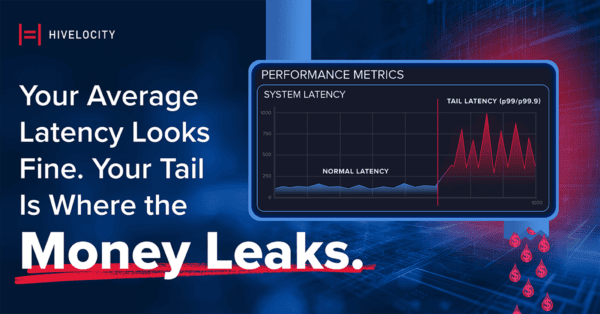
Average latency is a useful metric, but it can put a veil over problems that are actively costing your business. Sure: the board deck shows performance well within the SLA. But that 99.9th percentile reflects a different reality.
This is where tail latency rears its ugly head: the slowest request in every thousand. In an industry where execution speed always matters, these fringe incidents are still considerable problems.
After all, trading systems are judged by the outliers: the missed fill, the stale quote, the order that arrives too late. Tail latency is a common driver of these issues.
The Unpredictable Problems of Shared Infrastructure
Shared cloud environments introduce a lot of unpredictable factors that can cause the outlying latency incidents. For example, a noisy neighbor on the same physical host grabs CPU cycles for a few hundred microseconds. Or the hypervisor pauses your processing to schedule another tenant’s work. Storage attached over the network takes a longer round trip than usual.
Those don’t happen often enough to show up in the average. And every one of them lands in the tail. This means that the latency graph stays green, but the tail percentiles are still costing the business—often without any further investigation.
To be clear, the cloud isn’t the problem. It’s doing precisely what it was designed to do: pack many tenants onto shared hardware and absorb demand with elasticity. Elasticity is the feature you pay a premium for, and for most workloads it earns its keep. For a match engine, it is the source of the variance you are trying to eliminate.
The Bare-Metal Solution for Fintech
The critical priority for fintechs is to remove or reduce the events that create tail latency. Doing so requires something different than cloud.
This is where single-tenant bare metal comes in. Using such an environment, fintechs have no neighbor to share a core with and no hypervisor scheduling engine deciding when requests can be processed. Local NVMe keeps storage off the network, removing additional overhead from the path.
Just as critical are predictable network paths and placement. These put the infrastructure where variance is lowest , and the endpoints are closest.
For example, Hivelocity’s Orangeburg facility runs a direct dark-fiber path to Manhattan, in proximity to the major exchanges. This detail doesn’t mean much until it’s the difference between an order fill and a miss.
Likewise, Hivelocity’s proximity to the Intercontinental Exchange (ICE) in Chicago offers the same on the futures side, putting infrastructure within cross-connect reach of ICE’s Chicago presence, where its primary matching engine for futures and OTC products runs.
The same logic applies beyond trading desks. A proof-of-stake validator participating in a blockchain transaction that is too slow to get its attestation in on time—one attestation out of a thousand—is not opening a support ticket. But the incident may create a financial loss , confiscating the deposit, and that impacts the balance sheet.
Dedicated hardware removes the contention. However, it doesn’t write your match-engine logic, tune your kernel, or fix an application that runs slow. Hivelocity provides the metal, the isolation, and the network; what runs on top stays yours to optimize.
Fintech Optimization Extends Beyond Average Latency
What’s the takeaway for today’s CTOs? There’s a lot to gain by taking a look at how your system performs on its worst day, in its worst percentile, while the host next door is busy—and how that may be impacting the business.
If you’re ready to ensure you’re not losing money due to tail latency, Hivelocity is ready to help.
FAQ
Q: What does tail latency refer to?
A: Tail latency is the response time of the slowest requests in a system. It represents the worst part of the distribution, measured at percentiles like the 99th, 99.9th, or 99.99th. For latency-sensitive workloads, it’s often a more important metric than the mean. The slowest requests are the ones that cost money.
Q: What does 99.9th percentile latency mean?
A: 99.9th percentile latency is the bar that 99.9% of requests come in under. Examining it exposes the rare, severe delays that an average smooths over. A match engine or market-data fabric is judged on this figure.
Q: What causes latency spikes on shared cloud infrastructure?
A: Latency spikes on shared cloud come from contention you don’t control. Other tenants on the same physical host compete for CPU, the hypervisor scheduling engine pauses your processes to schedule another tenant’s work, and network-attached storage adds variable round trips. Each event is potentially infrequent, and each one produces a tail spike.
Q: Does single-tenant bare metal reduce tail latency?
A: Single-tenant bare metal narrows the tail by removing the contention that causes it: no neighbor sharing your cores, no hypervisor scheduling your workload against others, and local NVMe instead of network-attached storage. It won’t fix slow applications, but it removes the infrastructure-level variance.
