Key takeways
- The price of new hardware is only one part of the total cost of a technology refreshes.
- Organizations should consider facility upgrade expenses and opportunity costs of missed investments.
- Choosing colocation services enables organizations to capitalize on next-generation hardware while avoiding the high costs of facility upgrades.
When it’s time to refresh infrastructure, executive teams often focus primarily on the hardware. They evaluate the processor performance of new servers, assess the density of storage solutions, and scrutinize the throughput of networking gear. If they are considering multiple products, they compare not only upfront costs but also warranties and support. From there, they begin to calculate depreciation schedules.
Too often, the other costs of hardware refreshes are an afterthought—but they can be significant. Installing new infrastructure frequently triggers a range of additional investments, from power and cooling updates to environmental monitoring and physical security upgrades. Even when existing facilities can accommodate the new equipment, many organizations still need to upgrade existing systems to support the next generation of technology they plan to deploy.
These costs are easy to overlook because they rarely appear together with hardware acquisition costs on a single budget line, or even within a single team’s budget. Additional expenses could be spread across IT, facilities, operations, and finance budgets. As a result, the leaders driving the refresh initiative might find it very difficult to evaluate the full investment required to support the next hardware lifecycle.
The Three Costs of Every Hardware Refresh
How can an organization be sure they are capturing the total possible costs of a proposed hardware refresh? Evaluating the refresh through three distinct lenses is key.
Hardware: These are the most obvious costs, but there are still multiple components. Beyond the price of the raw physical equipment, there might be costs for shipping, deployment (including any outside professional services required), data migration tools, and support contracts. These all can be classified as direct technology costs.
Facilities: Hardware changes can have a significant impact on a data center. For example, an organization might need to add power or rack capacity. New systems might also require ramping up cooling or upgrading environmental controls that monitor temperature and airflow. To protect new assets, they might also need to strengthen physical security. And these are just the initial costs. Hardware refreshes could also change the economics of maintaining systems over time.
Opportunity cost: These are costs that are rarely accounted for when preparing for a hardware refresh. Every dollar an organization invests in new servers and facilities upgrades is a dollar they cannot invest elsewhere. They might miss opportunities to automate operations, strengthen cybersecurity, or deliver new customer experiences. Of course, the refresh might be completely necessary—and entirely worth it. But lost opportunities should be factored into planning.
Identifying all of these potential costs is an important first step. With that information, the next step is exploring strategies for achieving higher-level technology and business goals while controlling spending.
Moving Beyond Traditional Hardware Refresh Cycles
Given the very real possibility that a technology refresh will cost more than the price of the raw hardware, leaders often benefit from taking a step back and assessing the bigger IT picture. In particular, some take this moment to re-evaluate their cloud strategy.
The answer is rarely to move everything to the cloud. In fact, according to one recent survey, 98% of IT leaders have adopted or plan to adopt a hybrid IT model.1 Instead of asking whether everything belongs in the cloud or on-premises, they are evaluating each workload based on performance, cost, resilience, security, and operational requirements.
This type of assessment helps organizations move beyond traditional refresh cycles—and that’s a good thing. IT leaders can focus more on finding the right infrastructure for each workload rather than reflexively replacing systems when they reach their end of life. They might move some workloads to a cloud but decide to keep others on-premises, running on dedicated systems.
In some cases, organizations need another option. A particular workload might require the performance or security of single-tenant servers. But leaders might realize that the costs of also upgrading their data center—and foregoing other investments—are too great.
Rethinking Facility Options—and Choosing Colocation
Moving to next-generation systems often requires data center changes. In particular, deploying AI-ready servers with higher-density processors and large-scale storage solutions can place significantly greater demands on the environments where they operate. A server room that was perfectly adequate five or ten years ago might be unable to accommodate today’s—or tomorrow’s—infrastructure requirements.
Instead of upgrading internal facilities for every technology refresh, many organizations are now choosing a different approach. They are separating ownership of the infrastructure from ownership of the building.
Purpose-built colocation facilities enable organizations to pair particular workloads with their own dedicated hardware—while housing that hardware in a data center that they don’t have to upgrade. Colocation facilities provide the power, cooling, security, carrier-neutral connectivity, and operational support needed for enterprise infrastructure. By choosing the colocation model, organizations modernize the technology they own (as frequently as necessary) without continually modernizing the facility that houses it.
Don’t Let Yesterday’s Decisions Shape Today’s Strategy
One of the biggest challenges in infrastructure planning is preventing historical decisions from dictating current or future investments. A workload might be running in the cloud because someone made that decision five years ago. And an organization might be using their own data center because that’s where the servers have always been.
Those previous decisions might no longer be the right answer. A refresh cycle presents an opportunity to ask new questions, such as:
- Should that workload be running on dedicated hardware that we own?
- Does maintaining our own infrastructure still support the organization’s financial objectives?
- Does managing our own hardware provide the operational flexibility the business needs?
- Would our own infrastructure deliver greater value in an environment purpose-built to support it?
- Is valuable engineering talent focused on innovation—or facility management?
The answers to these questions could move an organization away from a costly IT refresh cycle to a new model that delivers technology, financial, and business benefits.
Taking a New Approach to Technology Refreshes
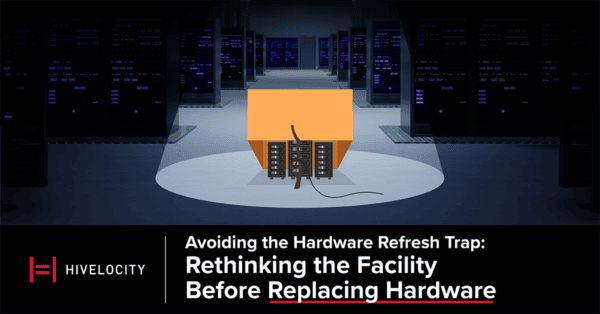
The next time your organization prepares for a technology refresh, avoid the trap of focusing exclusively on hardware. That trap could leave you with surprisingly large additional costs and less flexibility.
Beyond examining the price tag of new equipment, consider the potentially high costs for facility upgrades and the possible missed opportunities from not investing in something else. That more holistic cost evaluation could help you optimize your overall IT strategy.
You might decide that using colocation services gives you the best of all worlds. With the colocation model, you can capitalize on next-generation hardware while avoiding facility upgrades. That decision will enable you to meet workload requirements while leaving you greater flexibility—and budget—for change in the future. Learn more about refreshing hardware without making expensive facility upgrades.
FAQ
Q: What are the three key costs of hardware refreshes?
A: In addition to buying new hardware, organizations often need to upgrade data center facilities to accommodate these new systems. They also pay an “opportunity cost” when their refresh budget forces them to scale back other investments.
Q: How should organizations rethink a typical hardware refresh?
A: A hardware refresh is a good moment to consider the bigger picture of IT planning. Instead of focusing on replacing aging hardware, organizations should evaluate individual workload needs. A hybrid infrastructure that includes on-premises, cloud, and colocation services might be the right fit.
Q: How can colocation costs help organizations?
A: Using a purpose-built colocation facility—which provides power, cooling, security, connectivity, and operational support—enables organizations to refresh hardware without having to pay the high costs of facility upgrades.
Citations:
1. CoreSite, 2025 State of the Data Center, May 2025
