
Key takeaways
- Hosted streaming platforms promise reliability, but their infrastructure can’t always deliver.
- Shared cloud infrastructure can delay workload processing, leading to poor viewer experiences.
- Moving to bare metal infrastructure can improve reliability of streaming experiences while also reducing costs.
For hosted streaming platforms, maintaining exceptional reliability is critical for keeping TV network, enterprise, and educational customers. When an event starts, the stream has to work flawlessly.
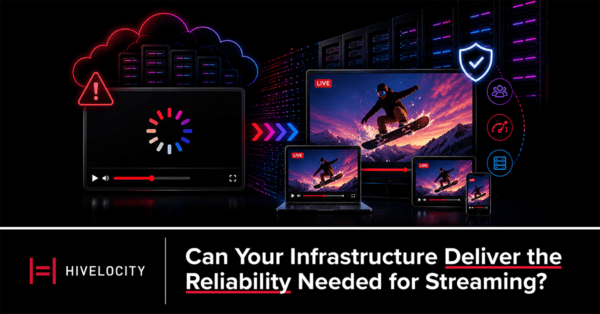
The problem isn’t that cloud providers lack delivery infrastructure; it is how that model is priced and provisioned. Egress is metered, so sustained, high-volume live delivery gets expensive and hard to predict as your audience grows, and the trade-offs platforms make to keep costs in line often show up as buffering or drops.
Streaming platform customers have no visibility into the streaming platform stack. They don’t see the origin server fielding requests or the transcoding pipeline trying to keep pace with ingest. And really, they don’t care. They just want to deliver smooth experiences to their audiences.
The questions for hosted streaming platforms are simple: How can you best deliver the reliability that your customers and their audience demand? And how can you do so at a cost that enables you to remain profitable?
Addressing the Structural Problem Affecting Reliability
To deliver a smooth live stream to thousands of viewers across a variety of devices, hosted streaming platforms must run live ingest and real-time transcoding workloads. Those workloads operate on very tight deadlines.
With a shared hypervisor infrastructure, consistently meeting those deadlines can be difficult. For example, a CPU might not be available at the precise moment when a segment needs to be encoded. If there’s a delay, the downstream result could be jitter, encoding artifacts, or a buffering issue that appears on the viewer’s screen.
The problem is structural: A cloud architecture supports multiple tenants at once. The workload scheduler for that architecture doesn’t realize that a streaming platform’s customer is about to broadcast a live program during a peak viewership window. The workload scheduler juggles multiple workloads, and sometimes the streaming platform’s workload has to wait.
By contrast, single-tenant bare metal infrastructure eliminates that resource-availability issue. With dedicated hardware paired with a CDN, the transcoding workload doesn’t compete for CPU time with workloads from other organizations. The streaming platform can avoid delays that degrade the viewer experience.
Improving Reliability While Reducing Costs
Reliability is not the only reason for streaming platforms to rethink using hyperscalers. The variable pricing model for cloud environments is also a poor fit for streaming.
Streaming platforms may have predictable peaks—like a high-profile sporting event, corporate conference, or weekly community broadcast. But in general, they have sustained, high-volume egress needs for ingest, transcoding, and other workloads. With the per-GB egress model, platforms could pay tens of thousands of dollars per month just for data egress—before adding compute, storage, and other cloud costs.
Using bare metal infrastructure with fixed pricing eliminates those large, unpredictable bills. That’s perfect for streaming workloads that run constantly, without fluctuation. As a result, streaming platforms can improve user experiences while significantly driving down costs.
Defining Responsibilities for the New Infrastructure
Before moving from a cloud environment to a bare metal infrastructure, streaming platforms should ensure that new vendors clearly define responsibilities. Bare metal infrastructure vendors should provide the single-tenant bare metal hardware, network connectivity, network-level security, and private networking between servers. For streaming platforms, those resources would handle ingest, CPU-based software transcoding, packaging, origin, and shield functions.
The streaming platform should retain control over other key decisions and responsibilities. For example, the platform should select the most appropriate content delivery network (CDN), handle digital rights management, and oversee the customer-facing delivery API. This division of responsibility helps streaming platforms capture the advantages of bare metal over hyperscale services while retaining control over their environment.
Meeting End-User Expectations at Lower Costs
Delivering reliable viewer experiences will remain the baseline for hosted streaming platforms. When these platforms fail to meet end-user expectations, they are very likely to lose customers.
For many platforms, meeting those expectations will require rethinking their current infrastructure. A shared cloud environment leaves too much room for workload delays that can noticeably impact viewer experience. Moving to bare metal infrastructure can alleviate those workload delays.
At the same time, adopting a predictable, consistent bare metal pricing model can help platforms significantly reduce costs compared with cloud providers’ variable egress fee model. With one migration from a hyperscaler to a bare metal infrastructure, streaming platforms can improve experiences and increase profitability.
Learn more about how to improve reliability and reduce costs with dedicated servers.
FAQ
Q: How does shared cloud infrastructure affect streaming reliability?
A: With shared cloud infrastructure, key streaming workloads—like ingest and transcoding—might have to wait in a CPU queue with workloads from other organizations. These delays can cause jitter, artifacts, or buffering errors on a viewer’s screen. Dedicated servers remove these error-causing workload delays.
Q: How does bare metal infrastructure reduce costs?
A: Moving to a bare metal infrastructure enables streaming platforms to pay predictable, fixed costs—and those bills are often much less than the bills generated from per-GB pricing.
Q: How should infrastructure providers and streaming platforms divide responsibilities?
A: Infrastructure providers should be responsible for the hardware, network connectivity, network security, and private networking between servers. The streaming platform, meanwhile, should retain control over the CDN, digital rights management, and customer-facing delivery API. This division of responsibilities lets platforms benefit from bare-metal infrastructure while retaining control of their environment.
