

Key takeaways
- IT infrastructure strategy is no longer as simple as adding hardware and expanding server rooms.
- C-suite leaders should work together to build an infrastructure strategy that balances technology and business goals with financial constraints.
- Colocation services enable organizations to retain control of hardware while avoiding facility expansion and operation costs.
An organization’s IT infrastructure strategy today can affect nearly every aspect of the business—from product design and customer experience to cybersecurity and office space allocation. Yet some companies continue to approach infrastructure strategy development as if it were a routine IT decision.
The formula used to be straightforward—and it didn’t really require input from the entire C-suite. As a business grew, so did the server room. IT teams installed additional racks, increased cooling capacity, upgraded backup power, and deployed another network circuit.
Today, new technology initiatives have become more central to supporting business goals. Expanding technology resources (such as new servers, storage, or networking equipment) is critical for moving the business forward. At the same time, however, technology expansion has come up against the physical limits of the building.
Moving to the cloud is an option sometimes, but not always. To meet performance, compliance, or security requirements, some workloads have to remain on dedicated hardware owned by the business.
Organizations, then, are faced with a few challenging questions: How do they best support tech-driven initiatives, like the adoption of AI tools, and continue to meet existing requirements, without consuming more commercial real estate? Just as important: Who should find the answer?
Extending Infrastructure Decisions Beyond IT
The first step in addressing the infrastructure strategy dilemma is to include more leaders in infrastructure decision-making. Many organizations are doing just that.
CFOs are asking whether another round of facility investments will deliver the same return as investing in product development or customer experience. CIOs are examining whether data center expansion will cut into planned modernization initiatives. CISOs are evaluating how new systems will affect cybersecurity and compliance. And CEOs are deciding whether facility spending is the best way to make the organization more agile.
Together, the C-suite is examining the full impact of infrastructure decisions on the business. They recognize that infrastructure is a strategic investment, and it must be evaluated alongside every other strategic investment.
That doesn’t mean they are deciding against owning infrastructure. They realize that—for some workloads—dedicated hardware, owned by the business, is crucial for providing predictable performance and greater control. The question is whether their office or data center is the best place for that hardware.
Calculating Opportunity Cost by the Square Foot
The high cost of commercial real estate forces leaders to make every square foot work harder and deliver greater value. Executives routinely evaluate whether their office space is being used effectively.
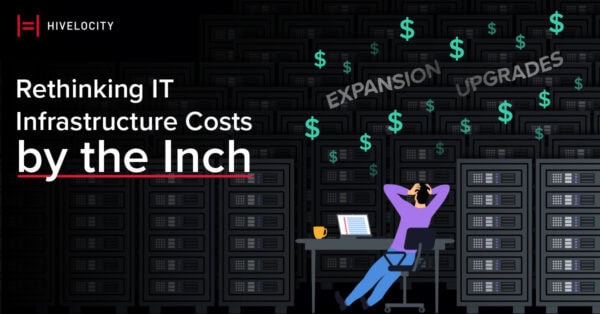
Until recently, though, server rooms often escaped the same level of scrutiny. And yet, those rooms can be extremely costly to run. A server room requires not only dedicated floor space but also electrical infrastructure, cooling systems, physical security, environmental monitoring, fire suppression, and ongoing maintenance.
That largely inflexible space represents an opportunity cost that few organizations calculate. When an organization reserves a space for servers, it can’t easily reconfigure the area to accommodate more employee desks or conference rooms. As companies bring employees back to corporate offices, the space occupied by IT gear now places a limit on internal growth.
Meanwhile, that technology depreciates over time—but commercial real estate rarely does. Organizations are spending the same (or more) every year to house equipment that is decreasing in value. They could instead use that money in ways that deliver a higher return on investment.
Reclaiming Budget and Real Estate with Colocation Services
Organizations have finite budgets, but they can spend that money in a wide variety of ways. Instead of buying new AC units or server racks for an overcrowded server room, many organizations might prefer to focus investments on aspects of their business that more directly create competitive advantage.
Using purpose-built colocation facilities can help organizations avoid costly expenditures for facility expansion and upgrades. With a colocation approach, organizations retain ownership and control of critical infrastructure while moving that infrastructure into facilities better equipped to handle change. Colocation facilities provide all necessary power, cooling,physical facilities security, connectivity, and operational support even as the hardware footprint grows.
With a colocation model, organizations can reduce the capital and operational costs for housing their hardware. They can reinvest that budget in more strategic initiatives. And if they choose, they can even reclaim some of that valuable office real estate for other uses.
Taking a Collaborative Approach to Strategic Decisions
Infrastructure decisions can no longer be IT decisions alone. Working together, the C-suite must find the best ways to enable tech-driven growth and innovation while consuming as little capital, real estate, and operational attention as possible.
In many cases, expanding the existing server room is not the best use of money. When organizations need to run workloads on dedicated servers, but would rather not spend their budget on facility upgrades, colocation is often a better approach. With colocation, organizations can conserve expensive office space and reserve budget for investments that more directly drive the business forward.
Learn how to retain control of your infrastructure while reducing real estate and facility costs.
FAQ
Q: What is the problem with traditional IT infrastructure decision-making?
A: Until recently, IT teams refreshed hardware and expanded server rooms as needed. But organizations are having to devote more of their budget to facility upgrades and costly real estate. Meanwhile, C-suites increasingly recognize that these decisions have business implications far beyond IT.
Q: What are the opportunity costs of server room expansion?
A: When organizations spend money on server room upgrades or expansion, they have less budget for business areas that more directly drive growth and innovation. When building an infrastructure strategy, executives need to decide whether consuming more of their costly commercial real estate to house hardware is the best way to spend money.
Q: How do colocation services address IT challenges?
A: Colocation services enable organizations to use dedicated hardware that they own within facilities that provide a full range of technical capabilities and operational support. Organizations can capitalize on the latest technology without having to invest in server room upgrades or take up additional real estate.
